
Aristotle Blume
And The Eye Of The Needle


We have been
waiting for you
Two years ago, Aristotle Blume lost everything. His parents. His Christmas. His belief that the world made sense.
Seven gates.
Seven worlds.
Seven trials.
Some worlds are worth the wait.
Book One available now in hardcover
and paperback on Amazon.
Welcome to the World of Aristotle Blume.
Discover


OBSIDIAN
It has a name for a reason.
The Blume estate sits on a basalt headland above the Salish Sea — dark stone on dark rock above dark water — nearly invisible in the coastal mist that rolls in from the Pacific Northwest and doesn't leave. Twelve thousand square feet of reinforced steel and polished stone, built in 1942 by Charles Albert Blume II with the particular philosophy of a man who had watched the only mansion on Nob Hill survive the Great San Francisco Fire because its builder believed in structure over beauty and integrity over appearance.
Obsidian was not built to impress. It was built to last.
Four generations of Blumes have lived inside it. Four generations of scholars, mystics, and obsessives who believed that the universe contained secrets worth a lifetime of pursuit. The library alone holds archives that have never been catalogued. The makerspace — two stories of equipment, LED screens, holographic projection, 3D printers — was built by Albert Blume for a son he was determined would have every tool the next chapter of the family's work might require.
The windows are bulletproof. The foundation is reinforced. The walls are thick enough to hold a century of secrets without strain.
From the water it looks like a fortress. From inside it looks like a home. From the outside in coastal mist it looks like almost nothing at all — which was always exactly the point.
Right now a twelve year old boy lives there with one housekeeper, a fortune he doesn't fully understand, and a Book that has already changed everything.
The estate is waiting to see what happens next.
So is everything else.
Chapter One Here!

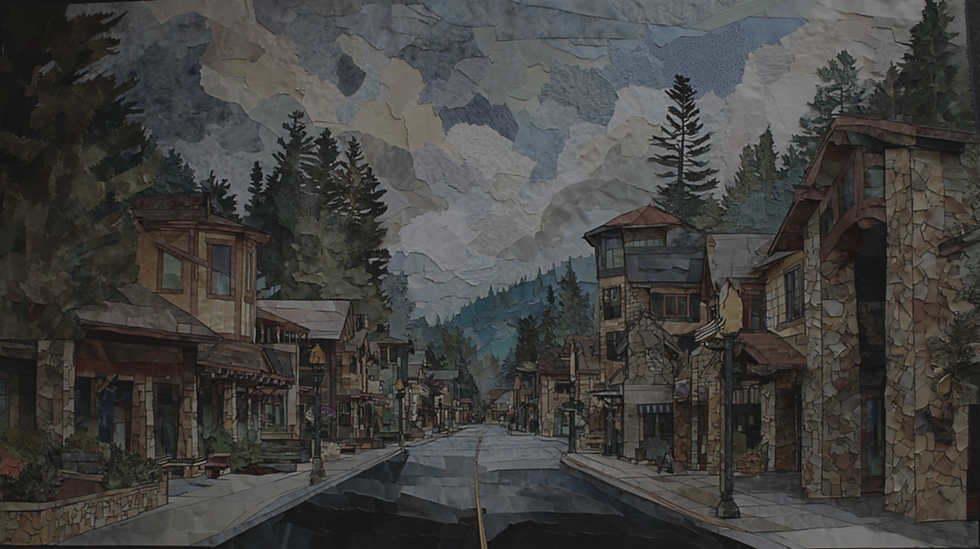
MT. SALISH
Don't let it fool you.
Mt. Salish sits west of Seattle on the edge of the Salish Sea — small enough to feel intimate, wealthy enough to feel effortless, and carefully curated enough that the effort never shows. The kind of town where the coffee shop looks rustic but the beans are imported from three different continents. Where the farmers market sells vegetables grown by people with advanced degrees in sustainable agriculture. Where the school is technically public but the PTA budget would make a private institution envious.
It is, in the most precise possible sense, a town that works very hard to appear as though it does not work at all.
The Blume family has lived here since 1942 — which in Mt. Salish terms makes them practically founding members, despite the fact that Charles Albert Blume II arrived as a reclusive scholar with no interest in the social fabric of the place and never changed that position for the remaining seventy-three years of his life. The town accommodated this. Old money in Mt. Salish is given a wide and respectful berth.
Aristotle Blume attends Mt. Salish Middle School. He rides in Uber Black cars because Mrs. Grey doesn't drive and the estate is up a private road through dense evergreens past stone pillars that mark the boundary of a property most of his classmates have never seen from the inside.
His friends Ollie and Abbie biked through a storm to reach him on Christmas Eve.
In Mt. Salish, that kind of loyalty is quietly noted and never mentioned.
Which is, come to think of it, exactly how the town handles everything that matters.